English
 русский
 عربى
عربىDefining the SMC Prefabricated Complete Bathroom: Beyond a Modular Unit
The construction industry’s pursuit of efficiency, quality control, and lifecycle durability has driven the evolution of modularization. At the intersection of advanced material science and offsite manufacturing lies the SMC Prefabricated Complete Bathroom, often referred to as an SMC bathroom pod. This is not merely a collection of bathroom fixtures installed in a box; it is a fully finished, volumetric room constructed primarily from Sheet Molding Compound, arriving on site ready for immediate connection to building services. To understand its significance is to recognize a paradigm shift from sequential, trade-dependent wet construction to a single-source, engineered assembly process that eliminates the variability inherent in traditional tiling and waterproofing.
An SMC bathroom pod is a structural envelope in itself. The floor, walls, and ceiling are compression-molded as monolithic or interlocking panels with integrated joint designs. Unlike concrete drywall or light-gauge steel frames that rely on applied membranes to achieve water tightness, the SMC material is intrinsically impervious to water. This fundamental material property redefines the lifecycle of the wet zone, transforming the bathroom from a potential long-term liability—prone to leaks and mold propagation—into an inert, sealed capsule. The definition extends to the complete integration of mechanical, electrical, and plumbing systems within the molded panels, effectively creating a plug-and-play utility unit.
The technical distinction gained clarity when we analyze the failure modes of site-built bathrooms. Traditional construction relies on the skill-dependent application of liquid waterproofing or sheet membranes behind tiles, a system that suffers from puncture risks, bond-break failures at stress points, and degradation at movement joints. An SMC pod circumvents these failure paths entirely because the structural composite is the waterproofing. The gel-coated, high-gloss surface resulting from the molding process produces panels that have zero grout lines on wall panels—often the weakest link in a traditional shower area. This system compresses four to six distinct trades into a single factory-controlled output, thus mitigating the risk of leakage that the insurance sector frequently cites as a primary source of building defect claims.
Deconstructing the Core Material: The Science of Sheet Molding Compound
To fully comprehend the value of these pods, one must dissect the material landscape. Sheet Molding Compound is a fiber-reinforced thermoset composite. The specific formulation used in sanitary unit production typically includes a blend of unsaturated polyester resin, chopped glass fiber reinforcement (usually 25% to 30% by weight), inert mineral fillers, shrinkage-control additives, thickening agents, and catalyst inhibitors. The synergy of these components under heat and high-pressure compression molding yields a cross-linked polymer structure that cannot be re-melted or softened—a defining characteristic that delivers exceptional dimensional stability under thermal fluctuation found in high-volume shower usage.
Comparative Material Performance in Wet Environments
While designers often discuss alternative materials like fiberglass-reinforced plastic (FRP), acrylic, or steel framing, the performance profile of SMC changes the conversation entirely. FRP, typically hand-laminated, flexes significantly and suffers from surface gel-coat micro-cracking due to a low modulus of elasticity over time. SMC, with its precisely controlled mixing and compression, achieves a flexural modulus typically exceeding 10 GPa, effectively resisting the micro-movements that eventually cause leak paths. This high rigidity-to-weight ratio permits thinner panels without sacrificing structural integrity; a typical SMC panel ranges between 4 mm to 7 mm for specific structural zones, unlike standard ceramic tile backer boards requiring 12 mm of mortar bed plus substrate thickness.
The fire performance characteristics are equally critical for vertical construction compliance. Standard FRP panels often carry a lower classification due to the styrene-monomer content remaining post-cure unless strictly quality-controlled. In contrast, the high-temperature compression molding of SMC produces a highly filled, inert matrix that, in specific compositions, achieves a Class B or even Class A fire rating rating per ASTM E-84 depending on the resin and filler mix design. This eliminates the need for additional fire-rated drywall behind the wet walls, a requirement often associated with plastic laminated bathroom walls.
Water absorption rates quantify the long-term resistance. The ASTM D570 test for water absorption in rigid paneling used for enclosures should ideally trend toward near-zero values. High-quality SMC composite exhibits absorption values consistently below 0.15% by weight, whereas cement-based backer boards typically absorb 5% to 15% and even marine-grade plywood absorbs several percent over prolonged humidity. This near-zero absorption is why SMC pods do not swell, delaminate, or provide a substrate for the biological growth cycle of black mold, a crucial detail for indoor air quality management in hotels and healthcare facilities.
The Anatomy of a Pod: Structural Components and Full Integration
A complete SMC Prefabricated Complete Bathroom is more than the sum of its panels. It is an engineered assembly where the base tray, wall panels, and ceiling form a cohesive structural hollow box that resists torsion during crane lifting. The manufacturing process begins with the ground structure, often an SMC floor base supported by an encapsulated steel chassis. This base is not flat like a standard shower tray; it is molded with an integrated upstand and a perimeter rebate into which the wall panels lock. The joint between the floor and wall is not a cold-joint gasket relying on sealant but a mechanical interlock backed by structural adhesive, converting the five-sided panel build into a quasi-monocoque shell.
The visible surfaces benefit from the in-mold coating (IMC) applied during the compression cure cycle at approximately 140°C to 160°C. This high-gloss thermo-set layer bonds on a molecular level with the substrate, not as a paint film but as a cross-linked surface layer with typical pencil hardness ratings of 4H or harder. In practical terms, this offers surface durability that resists scratching from abrasive cleaning agents or dropped toiletry items, sustaining the aesthetic finish for decades under heavy commercial occupancy.
Service integration represents the intelligence of the pod design. Water supply lines, drain-waste-vent stacks, and electrical conduits are pre-installed and concealed within the service void behind the panels or within dedicated chases. The philosophy of the "dry zone" applies: all service connections branch out to a single external connection point accessible from outside the pod, often within a ceiling void or a rear access panel located in an adjacent corridor. This consolidation simplifies on-site commissioning dramatically. Quality assurance protocols inclusive of factory pressure testing of the plumbing at 1.5 times the operating pressure for a specified duration ensure no concealed system contains a latent pinhole leak before the pod leaves the factory floor.
Dimensional control represents a hidden metric critical to project success. Pods are manufactured to precise external specifications with allowable tolerances frequently held within ±2 mm for the rectangularity of the external shell. This precision enables architects to specify tight construction joints with adjacent partition walls, eliminating oversized door gaps and easing the installation of modular MEP racks. This level of manufacturing accuracy cannot be achieved with wet trades, where masonry variance or stud alignment drift can accumulate to centimeters across a floor plate.
| Performance Attribute | Typical Value/Range | Significance |
| Panel Wall Thickness | 4 mm – 7 mm (Wall Panel) | Maximizes net internal floor area |
| Water Absorption Rate | < 0.15% (ASTM D570) | Eliminates mold substrate potential |
| Surface Hardness | 4H+ (Pencil Hardness) | High scratch and cleaning-agent resistance |
| Fire Rating Potential | Class B / Class A (ASTM E-84) | Meet vertical riser and occupancy codes |
The Manufacturing-to-Installation Workflow: Factory Precision Meets Site Speed
The logistical sequence from raw material to a functional bathroom suite distinguishes this technology. The factory floor is organized in a cellular assembly line, beginning with the SMC compression presses. A measured charge of the sheet compound is placed into a matched-metal die heated to approximately 150 degrees Celsius. Under hydraulic press pressure, the compound flows to fill the mold cavity, cross-linking chemically within 2 to 4 minutes to form the textured, ready-to-use panel complete with integrated soap niches, shelving, and grab-bar block backing. These panels cure instantly into a chemically inert state, moving from tool to the assembly cell without the volatile off-gassing associated with onsite polyurethane foams. Once the base tray has been leveled on a calibrated jig, the wall panels are bonded using a structural methacrylate adhesive that produces a joint as strong as the parent material.
The subsequent station installs the complete sanitary ware: the WC, vanity, shower enclosure glass, and shower valve diverter trim. The installation proceeds in reverse sequence compared to site work. Rather than fitting sheetrock around plumbing, the plumbing is fitted into the pre-molded panel. Lighting fixtures, extraction fans, and safety grounding all terminate at a central junction box. The critical checkpoint is the factory acceptance test, where a team conducts a 24-hour floor flood test or monitors pressurization. This quality gate physically confirms the absence of leaks before shipment. Once the test ticket is signed, the pod is wrapped in protective film and is frequently loaded as "fully furnished" in the scheduling software, ready to integrate with the vertical transportation plan.
Site handling and cranage require a logical sequence. The pod, usually weighing between 300 kg to 800 kg depending on sanitary ware density, is lifted to its designated level and rolled on skates or dollies into position. It is set onto a pre-leveled structural subfloor—often a recessed slab detail—one that ensures a flush transition from corridor flooring into the imperceptible floor drain gradient. Connections are made at the service access hatch: incoming hot and cold supplies, the branch circuit connection from the distribution board, and the connection of the flexible waste pipe to the stack. A two-person crew can typically install and commission a pod in less than four hours from tailgate to a flushing toilet, compressing a site-schedule that previously occupied multiple subcontractors over several weeks.
The time savings become particularly striking when examined across multi-unit projects. While structural drying times for screeds and tile adhesives create fixed latency in a project's critical path, the SMC pod approach overlaps the fit-out duration with the structural framing entirely. The following table illustrates the impact on schedule compression:
| Construction Phase | Traditional On-Site (Days) | SMC Pod Method (Days) |
| Waterproofing & Curing | 3 – 5 | 0 (offsite concurrent) |
| Tiling & Grouting | 5 – 8 | 0 (integrated finish) |
| MEP Rough-in & Trim | 2 – 3 (sequential) | 0.1 (site connections) |
Technical Advantages: Hygienic, Acoustic, and Waterproof Integrity
While speed and leakage prevention dominate the conversation, the technical advantages of the SMC bathroom pod touch on building physics subtleties that influence the quality of life for users, particularly in the healthcare and senior living sectors. The first is the seamless hygienic surface. The molding process can encapsulate coving radii at internal corners, eliminating the 90-degree joints where pathogens accumulate preferentially. The non-porous, continuous gel coat supports aggressive decontamination protocols using quaternary ammonium disinfectants without the risk of degrading a cementitious grout matrix over time. The hygienic philosophy for this product type is therefore based on surface intolerance to bacterial attachment, a key criteria in creating medical-grade environments.
Acoustic attenuation within high-rise multi-family buildings demonstrates another layer of technical merit. Lightweight pods have the potential to transmit pump noise or water hammer if not engineered properly. In response, manufacturers design a decoupled floor base. The SMC floor tray floats on a vibration damping mat over the structural slab, while the wall panels incorporate a constrained-layer damping back-coating. These treatments convert vibration energy into negligible heat, reducing the sound pressure level transmitted to adjacent living spaces to well under the 45 dBA threshold often targeted for interior ambient noise. Conversely, the monolithic nature of the SMC shell acts as a mass barrier, limiting the direct flanking path of bathroom ventilation noise through the ceiling plenum.
The waterproof integrity goes beyond simple material properties and into system integration. The floor waste receptor is not merely a drain inserted through a hole in the floor; it is compression-molded into the base tray during its initial forming cycle or chemically welded post-molding, creating a flange that integrates with the base’s gradient. The 1:50 fall toward the waste is part of the tool geometry, not a variable completed by a floor screeder on site. Because the gradient is a tooled surface, the system maintains a perfectly consistent drainage slope without water pooling that often results from site-based variations in mortar bed thickness. This precision-defined slope increases the dwell time of hot water in contact with the surface marginally, simplifying cleaning by ensuring all residual water is evacuated entirely.
Design and Configuration Flexibility in Volumetric Construction
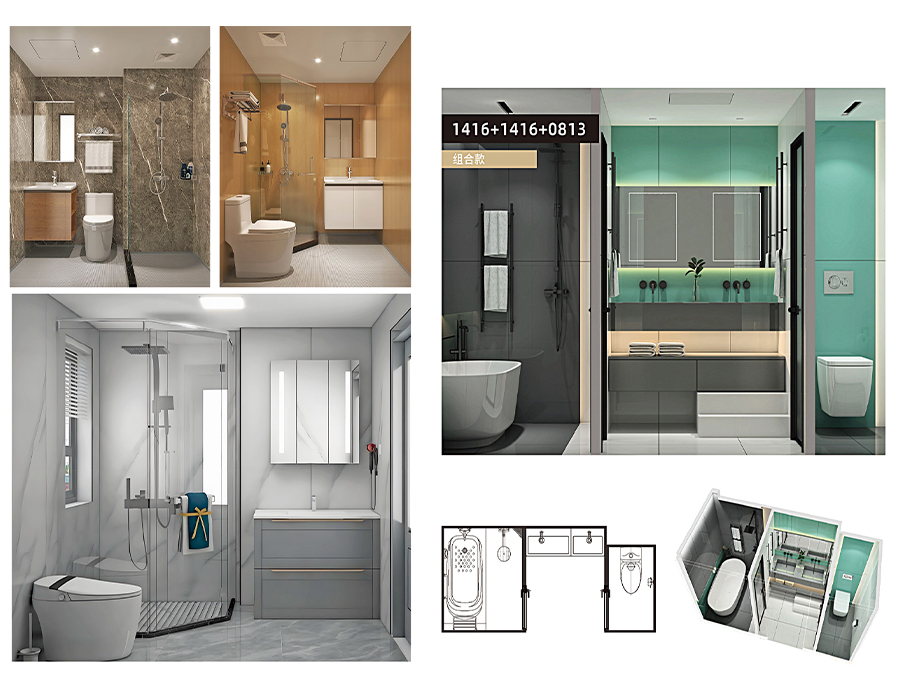
Dismissing prefabricated bathrooms as a limited catalog of cookie-cutter shapes reveals a misunderstanding of the mold tooling. While a fixed steel tool represents a capital investment, the tool concept in modern factories relies on interchangeable mold inserts. This allows for the repositioning of niches, the length of sink countertop wings, and the inclusion of obscure glass block paneling apertures without changing the base tool. The palette of in-mold color possibilities is wide, often encompassing hundreds of shades with a consistent color-through depth, because the pigment is integrated into the compound, not sprayed on the surface. This offers architects the flexibility to specify wood-effect or concrete-textured matte finishes while still benefiting from the composite substrate's performance.
Compliance with accessibility standards such as ADA or local universal design guidelines presents a specific set of dimensional challenges that SMC pods address elegantly. The required 1500 mm turning radius for wheelchairs mandates precise interior dimensions, which compete with the need to keep external pod dimensions compact for maximum floor efficiency. Because SMC panels are substantially thinner than a 90 mm steel-stud plus 13 mm drywall cavity, the achievable clear interior dimension for a given external frame is larger. Furthermore, the composite material permits the direct integration of structural backing for fold-down shower seats and the routing of a reinforced panel area for secure grab-bar installation, all without breaking the waterproof membrane integrity through on-site drilling as would be required in a tiled alternative.
Lifecycle Assessment, Sustainability, and Long-Term Value
The embodied carbon calculation for a prefabricated pod requires a nuanced understanding of waste streams. A traditional bathroom produces construction waste in forms of off-cut tiles, empty adhesive buckets, cement packaging, and gypsum board scrap, all of which are contaminated with mixed materials and diverted to landfill at substantial cost. The factory fabrication of an SMC pod operates on a closed-loop trimming and regrind process for its thermoplastic edge trim, while thermoset SMC flash can be downcycled. Critically, the factory-precut philosophy means that the bathroom arrives without packaging for a hundred individual fixtures, only the protective external panel skin. Consequently, on-site waste generation is reduced by an observed factor of up to 90% by weight in studies conducted on mid-range hotel fit-outs.
Operational energy use of the building over its life often outweighs initial carbon costs, and SMC pods deliver positive operational impact. The fan coil units serving hotel suites depend on a consistent vapor barrier integrity to prevent humid air from the bathroom from migrating into the suite and overloading the cooling coil. SMC pods provide a 100% effective perimeter vapor seal as a consequence of their monolithic assembly, eliminating latent cooling load anomalies. The cleaning and maintenance protocol for a tiled bathroom in an airport or sports arena includes periodic re-grouting and the replacement of failed silicone, generating chemical-use and plastic-waste volume over each maintenance cycle. The SMC panel, by contrast, is restored using only mild detergent and microfiber, significantly lowering the facility maintenance total cost of ownership over the typical 25-year plus service life evaluation of the asset.
The reusability and adaptability of modular units also factor in. When commercial spaces undergo a refresh cycle, SMC pods can be uncoupled from the services and relocated internally within the building shell, or even moved to a new site if the building undergoes complete demolition, a concept not achievable with mortar-bedded tiled floors. This potential for re-deployment extends the functional lifecycle of the embodied energy already invested in the composite manufacturing phase and positions the element as a long-life, loose-fit adaptable building component.
Practical Considerations for Specification and Site Coordination
Success with the technology begins at the structural coordination stage. The most common installation oversight is failing to account for the recessed receiving slab. Because the pod floor base has a very specific depth—often a composite sandwich panel—engineers must create a depressed slab pocket, typically 30 mm to 70 mm deep, so the finished pod floor aligns flush with the adjacent corridor tile or carpet. The recess must be flat to a tight tolerance. To address this, the general contractor often specifies a self-leveling underlayment in the slab pocket early in the program, allowing the pod to be lowered directly onto a level platform without shimming. Another coordination point involves the overhead mechanical services. The pod ceiling, molded with a slight washable texture and integrated light panel apertures, requires a designed service void above of roughly 200 mm to 300 mm directly accessible from a hallway hatch for future exhaust fan replacement without entering the occupied bathroom.
Crucially, the design team must factor in the pod’s structural independence from the adjacent wall framing. The pod is not a load-bearing element for the building but must be designed to stand independently against moderate building sway. Connections to surrounding partitions use a slip-track detail: an extruded edge trim on the pod perimeter accepts an acoustic sealant joint and a deflection track from the drywall partition, guaranteeing the structural isolation of the bathroom unit so building drift does not stress the composite shell. This resilient mount prevents gel-coat stress cracking—not through material enhancement alone, but through holistic design detail.
- Depressed slab tolerance must be verified with a laser level prior to pod receiving.
- Service shaft location must align with the external pod connection plate within a 50 mm positional tolerance.
- Protection of the finished gel-coat from subsequent trade activities (e.g., welding sparks) requires a protective board layer until final clean.
Cost Composition and Economic Logic of the SMC Pod
The economic value proposition of the SMC bathroom pod transcends simple material comparison per square meter. The financial model rests on the reduction of preliminary and general condition costs. A traditional bathroom construction requires months of safe access, temporary lighting, elevator usage for material hauling, and constant supervision of multiple trades, whose faults often become visible only in the final pressure test. By shifting this work off the critical path, the general contractor compresses the overall construction loan interest draw and reduces the general site overhead. Additionally, the predictability of the factory budget eliminates the contingency allowances typically needed for water-damage remediation before even practical completion.
From a maintenance reserve perspective, operators quantify costs over a 10-year capital replacement period. A tiled bathroom may require silicone replacement annually, regrouting every few years in hard-water regions, and potential tile replacement due to impact damage. An SMC pod will typically not require any of these interventions, with the only scheduled maintenance items being the exhaust fan motor and shower mixer cartridge—components common to both modalities. The saving in housekeeping chemicals and labor for deep cleaning grout lines is significant; the quick, seam-free surface often allows up to a 40% reduction in cleaning time per unit according to hospitality space audits. This translates to fewer staff hours or higher room turnover rates in a hotel environment, an operational advantage built directly into the material choice.
Frequently Asked Questions
Q1: What exactly is a prefabricated complete bathroom made of SMC?
It is a fully-integrated modular bathroom unit constructed in a factory using Sheet Molding Compound—a high-strength, compression-molded composite of polyester resin, glass fibers, and fillers. The floor, walls, and ceiling form a single, waterproof structure delivered to the site with all plumbing, electrical, and fixtures pre-installed.
Q2: How does an SMC bathroom pod address mold and water leakage long-term?
The non-porous material absorbs virtually no moisture, eliminating the substrate mold requires. Water leakage is prevented by eliminating field-applied waterproofing—the SMC panel itself constitutes an impermeable barrier, and joints are permanently bonded through structural adhesives, not silicone sealants that degrade over time.
Q3: Can the wall surface of an SMC pod match specific design aesthetics?
Yes. The in-mold coating process can produce high-gloss, matte, engineered stone, or wood-tone effects in a wide range of colors. The pigment is integrated during molding, so the color runs through the structural gel-coat layer and resists fading, offering design flexibility without sacrificing the waterproof properties.
Q4: In what type of building projects does the SMC pod deliver the most value?
Projects with repetitive bathroom layouts and high moisture exposure benefit the most. These include multi-story hotels, purpose-built student accommodation, assisted living and healthcare facilities, and large multi-family residential towers where construction speed, quality consistency, and minimizing noise transmission are priorities.
Q5: What maintenance is required for the SMC surface in the long term?
Routine cleaning needs only a non-abrasive, mild detergent with a soft cloth or sponge. Because there are no grout lines to deteriorate or porous surfaces to seal, there is no need for periodic re-grouting or silicone replacement, resulting in very low lifecycle maintenance effort and cost.